On December 31, 2024, the project “Prevention of plastic waste to reduce its impact on the Caribbean Sea of Guatemala, through innovative methods, with the participation of the academic sector, private sector and community” was successfully completed, within the framework of the regional circular Caribbean project, which began in January 2022.
It was financed by the German Society for International Cooperation (GIZ), for an amount of €123,802.10, equivalent to Q 1,015,177.22, which was administratively coordinated by the General Secretariat of the Central American Higher University Council (CSUCA) and executed by the Caribbean Research Institute, of the University Center of Izabal, of the University of San Carlos of Guatemala
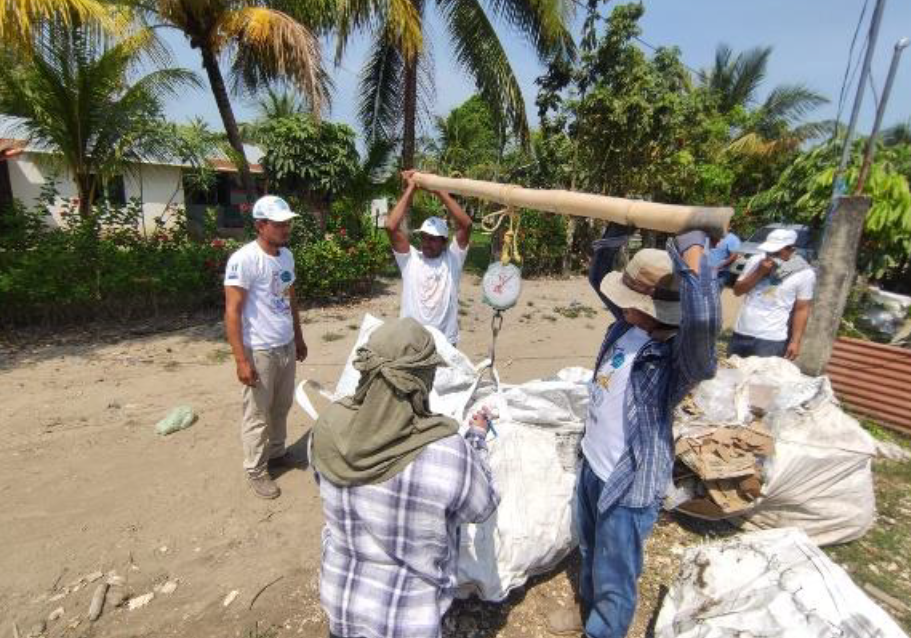
The project was implemented at the mouth of the Motagua River, with the participation of residents from the communities of El Quetzalito, Las Vegas, and Medialuna. They carried out clean-up and collection activities to process the waste collected by the Ministry of Environment and Natural Resources' (MARN) bio-barrier, which operates a plastic collection and separation system in the area. These activities have allowed the region to unite the efforts of various organizations, such as MARN, the Municipality of Puerto Barrios, and other institutions, to prevent plastic waste from entering the Caribbean Sea.
Some of the project's key results include:
More than 800 people participated in the environmental education program across more than 10 courses. 8.61 tons of plastic were collected, compacted, and recycled in the production of eco-asphalt. A manual for incorporating plastic waste into asphalt was developed. A mobile processing system was created for educational and awareness-raising purposes. A feasibility study was conducted for the clothing and textile sector in Puerto Barrios, Izabal. A guide to home composting was published. A baseline study of the municipality of Puerto Barrios was established using the Waste Flow Diagram tool.
A strengthened multi-year strategic plan, monitoring, and communication strategy for the Motagua River Basin Alliance. Five plastic processing plants receiving technical assistance. A diploma program in Integrated Solid Waste Management.
Five schools trained and equipped for the prevention and management of recyclable waste. A roadmap for a housing prototype using difficult-to-recycle materials.
Support for local campaigns of Reciclemos.gt and Think responsibly, avoid disposable items
Two environmental management policy guides for Small and Medium Enterprises (SMEs), food sector and diverse manufacturing.



 English
 Español de Guatemala