
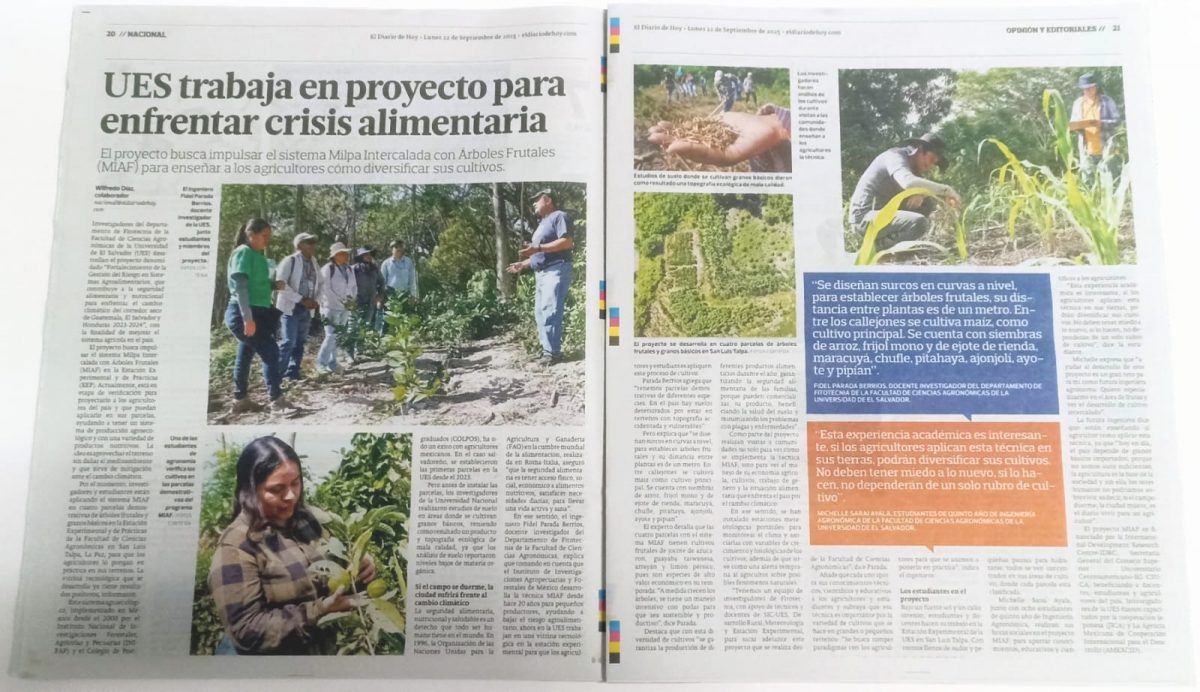
During September and October, the University of El Salvador (UES) developed a series of activities aimed at strengthening scientific research, technological innovation and support for agricultural producers, as part of Project 7-GT and the University Scientific Researcher Week.
Dissemination of advances in food security
Within the framework of Project 7-GT, the online newspaper Contrapunto published an article titled “UES Develops Food and Nutritional Security Proposal to Address the Food Crisis” on September 12. The article highlighted UES's progress in formulating a comprehensive proposal to address the national food crisis, reinforcing its institutional commitment to applied research and sustainability.
Conference on Artificial Intelligence applied to scientific research
As part of the University Scientific Researcher Week, on September 24, the conference series was held in which the presentation "Artificial Intelligence applied to Scientific Research" was given by the Digital Transformation consultant Andrés Conde, who has more than 25 years of experience in international markets and is co-founder of Somos tuIA.
The conference was held virtually via Google Meet and introduced the academic community to new technological tools applied to research work.
Installation of agrometeorological stations
Within the framework of Project 7-GT, UES installed new agrometeorological stations designed to strengthen agricultural resilience to climate change on September 27.
These stations record detailed data on temperature, humidity, rainfall, solar radiation, wind speed and direction, evaporation, evapotranspiration, precipitation, and leaf wetness. The information collected is essential for detecting pests and diseases, optimizing water and fertilizer use, and improving farmers' decision-making.
Reference video: https://youtu.be/dk95z-X14Xs?si=PjR-wvR105UmfwHL
First field tour with farmers: presentation of technological showcases
As part of Project 7-GT-UES, the first field tour was held on October 10th, aimed at farmers in the area of influence of the Experimental and Practice Station of the Faculty of Agronomic Sciences.
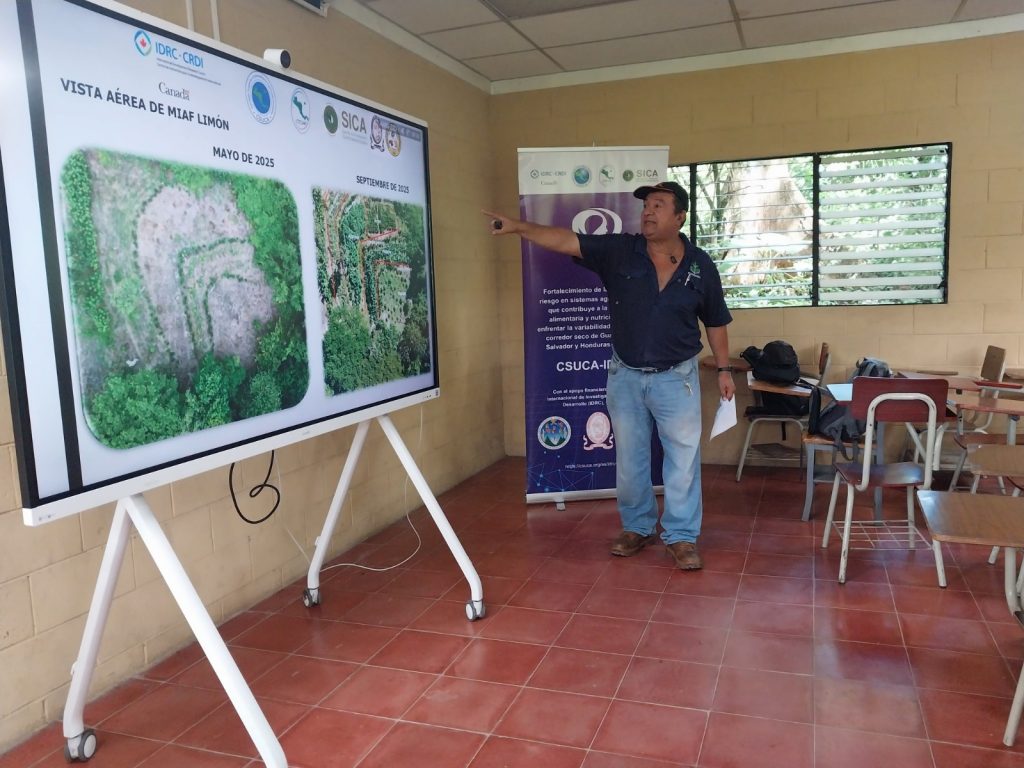
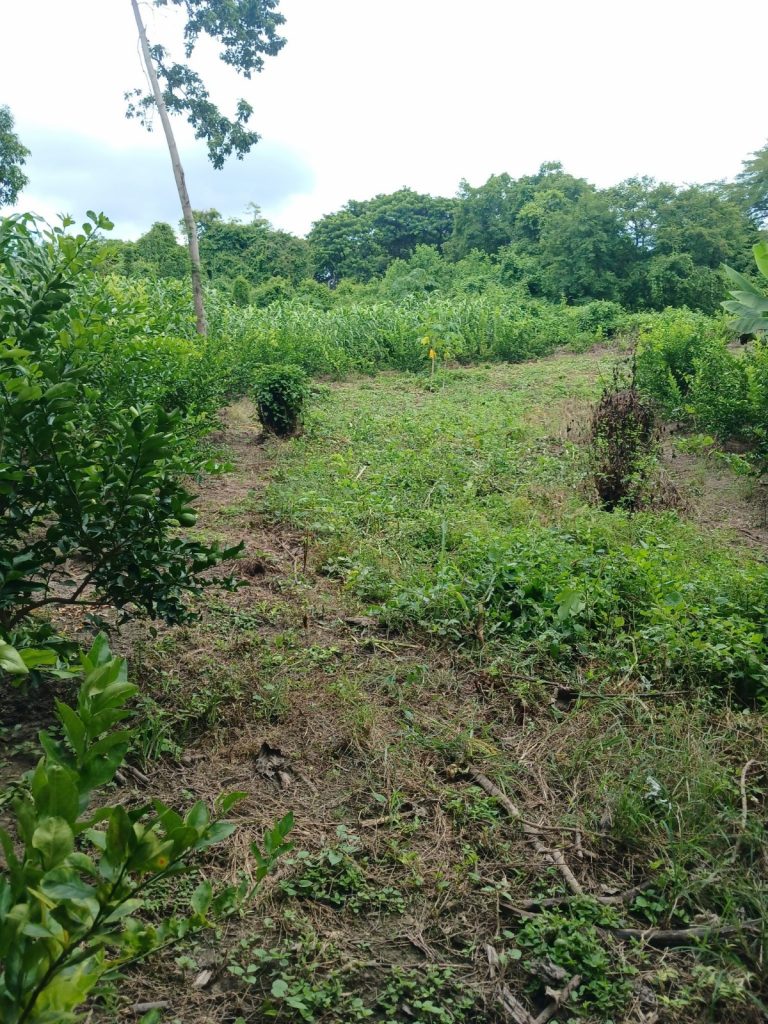
During the event, several MIAF technology showcases were presented, including:
- MIAF 1: Persian lime as an epiculture, accompanied by papaya, banana, sesame, rice, corn and sorghum.
- MIAF 2: Jocote de Azucaron with associated crops such as corn, sesame, chufle, green bean, sorghum, pitahaya and passion fruit.
- MIAF 3: Myrtle as an epiculture, along with corn, sorghum, rice and monkey bean.
- MIAF 4: Taiwanese guava accompanied by black corn, sesame, rice, soybeans and sorghum.
The plot of roots and tubers was also presented, showcasing crops such as cassava, taro, tiquizque, turmeric, papaya, and ginger, among others. These species represent high-value alternatives for strengthening food and nutritional security in rural communities. As part of the technical exchange, germplasm was offered for their propagation.
Donation of seeds to producers of the San Cristóbal Cooperative
On October 16, the rice and sesame harvest from the MIAF Persian Lime system was delivered to the producers of the San Cristóbal Cooperative.
The donation, received by Mr. José Valdez, president of the cooperative, will be used as seed to establish new cultivation areas on his land, contributing to the strengthening of local production and access to quality seeds.
 English
  Español de Guatemala