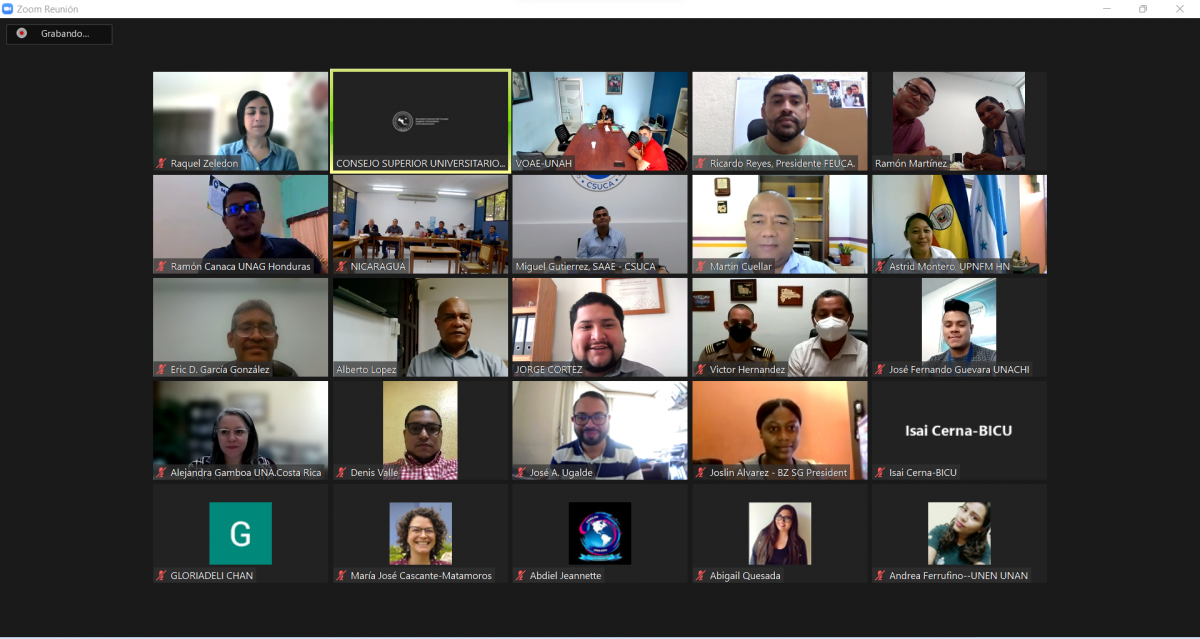
In the context of the project Distance education: an opportunity for all, Led by the State Distance University (UNED) of Costa Rica and funded by UNESCO, the activities included an internship for academics who, through the project, are trained in distance education, in order to learn about the development and the substantial strategic areas of the UNED educational model.
The project began with the participation of 25 academic staff members from the following universities: National Autonomous University of Nicaragua (UNAN-Managua), Technological University of Panama (UTP), Francisco Morazán National Pedagogical University (UPNFM, Honduras), University of El Salvador (UES), University of San Carlos of Guatemala (USAC), and Autonomous University of Santo Domingo (UASD, Dominican Republic).
During the period between February 16 and 21, the first group of interns was received. This group consisted of twelve academics from the Autonomous University of Santo Domingo, Dominican Republic (UASD), who carried out the internship, participated in the various scheduled activities and were able to relate what they had studied in the modules they had taken.
A second group of students visited UNED from March 27 to April 2, coming from universities in the Central American Isthmus, including UTP, UPNFM, UES and USAC, who also experienced getting closer to the development of UNED, in particular to understand the educational model through the activities carried out during the internship and relate the topics already studied.
The project Distance education: an opportunity for all It is led at UNED by a team consisting of Dr. Yarith Rivera Sánchez, who coordinates it; Dr. Viviana Berrocal Carvajal, co-coordinator; and Dr. Evelyn Gutiérrez Soto, all three officials from the School of Educational Sciences (ECE); Eng. Cecilia Barrantes Ramírez and Licda. Maritza Rojas Pérez, both officials from the Directorate of Internationalization and Cooperation (DIC)
The initiative has received the collaboration and support of the Rector of UNED, Rodrigo Arias Camacho, the Academic Vice-Rector, Maricruz Corrales Mora, and the Director of ECE, Linda María Madriz Bermúdez. The project was declared of institutional interest by agreement of the UNED Rector's Council, session 2197-2021, Article I, paragraph 10), held on November 15, 2021.
Regarding the work carried out, Yarith Rivera Sánchez, the project coordinator, commented: “The project consists of transferring knowledge and experiences to six universities in the Central American region and the Dominican Republic. The main objective is for the participating higher education institutions to develop, improve, or strengthen distance education models using virtual platforms, thus facilitating education for people who, due to various circumstances, are unable to attend universities in person, considering the current situation.”.
The project was born in response to the challenges presented by the new global reality in the field of higher education, which has been severely affected by the COVID-19 pandemic. UNED obtained approval for the project from the United Nations Educational, Scientific and Cultural Organization (UNESCO), within the participation program for the 2020-2021 biennium.
In this context, Rodrigo Arias Camacho, rector of UNED, stated: “It fills us with satisfaction to be able to share our educational model with the universities of Central America and the Dominican Republic, because we believe that what we called the new normal two years ago implies profound and permanent modifications in education, where progress has been made, consolidating new ways of learning in the teaching and learning process, and which forced us to carry out these new changes with creativity, which must not only be improved day by day; but learning services must be equitable, so that people can learn at any time and in any place.”.
Maricruz Corrales Mora, Academic Vice-Rector, emphasized the importance of the initiative and its connection to distance education, thanks to “the collaborative work that has allowed us to overcome challenges as complex as those we have experienced in the last two years with the pandemic. In this sense, this project contributes to strengthening the human talent that makes it possible to share our educational model, which demands a series of content and educational virtualization processes that allow us, as an institution and as faculty, to be closer to the student. Therefore, distance education is not simply about putting content on the internet; it is a whole systemic vision of education where a significant leap has been made in education in general, where the teacher is an institutional figure, marking a clear difference from the traditional university education model.”.
During the internship, the participants learned about the work of various departments such as the Directorate of Production of Didactic Materials (DPMD), as well as its programs: Production of Written Didactic Material (PROMADE), Videoconference and Audiographic (VICOM), Production of Audiovisual Material (PPMA), Online Learning (PAL), Multimedia Electronic Production (PEM), in addition to the facilities of the Center for Information, Documentation and Bibliographic Resources (CIDREB), the UNED Publishing House (EUNED), the Center for Training in Distance Education (CECED), the Curricular Support and Learning Assessment Program (PACE).
The internship also included visits to the university campuses in San Marcos, Puntarenas, Orotina, and Escazú, which allowed the interns to gain a general understanding of how a campus operates, learn about the services they provide to the community, and understand the new challenges facing UNED from its campuses and the importance of its outreach in the territories.
Linda Madriz Bermúdez, director of the ECE, highlighted the importance of the project, stating: “First, we share a series of realities, limitations, and challenges with our sister universities in Central America. Learning together and collaboratively can be far more meaningful than simply importing proposals. Second, distance education, in its various forms, is here to stay, and the pandemic reinforced its effectiveness as the form of education that truly facilitates and ensures equity and opportunities for all people, regardless of their location. However, there are also challenges, because while it is a wonderful opportunity, we must ensure its quality so that it is truly meaningful for those who have a need to learn.”.
Finally, it is essential to highlight that the project offers UNED the opportunity to once again showcase, at an international level, the development and knowledge in the field of distance education, and it enables participating universities to acquire tools and knowledge to understand the model, improve existing practices in the represented university contexts and initiate processes towards this educational model.
The participating academics they think
Mariela Román Barrios, a professional advisor specializing in Distance Education in Virtual Environments at the Postgraduate Studies System (CG-SEP) of the University of San Carlos of Guatemala, commented that “the contributions she received from the internship were excellent, thanks to the UNED staff. It truly demonstrates a commitment to the Central American educational community, supporting higher education institutions that are in the process of implementing distance education. One learns in a profound and meaningful way about the organization, processes, experiences, and the professional, mediated, and organized execution of distance education projects.”.
Román Barrios also stated: “I am deeply grateful for the knowledge acquired, which is very practical and motivates us to continue in the planning, execution and evaluation of remote projects in virtual environments in the Postgraduate Studies System of the University of San Carlos of Guatemala.”.
Along the same lines, Lorena Margarita Ramírez Mercado, a university professor and coordinator of the first Distance Education course at the Faculty of Chemistry and Pharmacy of the University of El Salvador, stated: “This internship seems extremely important to me for fully understanding the distance education model and for realizing that this model involves a whole institutional organization and commitment, where a series of departments or units provide the necessary support and guidance to teachers and students so that the model functions and improves day by day. Furthermore, this model guarantees the right to education for all and allows the university to reach even the most remote communities. This internship has shown me the importance of institutional organization where everyone works in a coordinated manner toward a common goal.”.
The representation of the Francisco Morazán National Pedagogical University fell to Jenny Margoth Zelaya Matamoros, who is the Vice-Rector of Distance Education and who pointed out that “the internship is the academic activity that brought together all the modules we have taken so far. The internship gave meaning to all the concepts learned.”.
From Panama, project engineer Luiyiana Del Carmen Pérez participated, who is the coordinator of the Faculty of Computer Systems Engineering at the Azuero Regional Center of the Technological University of Panama, who noted that “the internship has been the culminating activity of the diploma program for me Distance Education: An opportunity for all, This has allowed me to internalize all the knowledge acquired during almost a year of distance learning, as well as clear up any doubts I had about the UNED's distance education model. It has been invaluable to observe all the work coordinated by a multidisciplinary team, all motivated by a common goal: to offer education to an entire population without borders. With its 45th anniversary, UNED is projecting itself internationally with a solid foundation in distance education, through the integration of five programs: PROMADE, PMA, PEM, VAU, and PAL, all aligned with the PACE guidelines.
“This internship has given me a successful training model, thanks to a staff that fosters values such as service and empathy for vulnerable populations, and synergy through teamwork, always going the extra mile to offer the opportunity to delve into the wonderful world of knowledge and contribute to the professional development of the community. Thanks to UNESCO for the opportunity and to UNED for opening its doors to replicate its model at the Technological University of Panama. I conclude with this quote from Albert Einstein: “The mind that is opened to a new idea never returns to its original size,” said Del Carmen Pérez.”.
For more information about this project, you can contact Yarith Rivera Sánchez at the following email address: yrivera@uned.ac.cr to Cecilia Barrantes Ramírez at the following email address: cbarrantes@uned.ac.cr
evgutierrez@uned.ac.cr